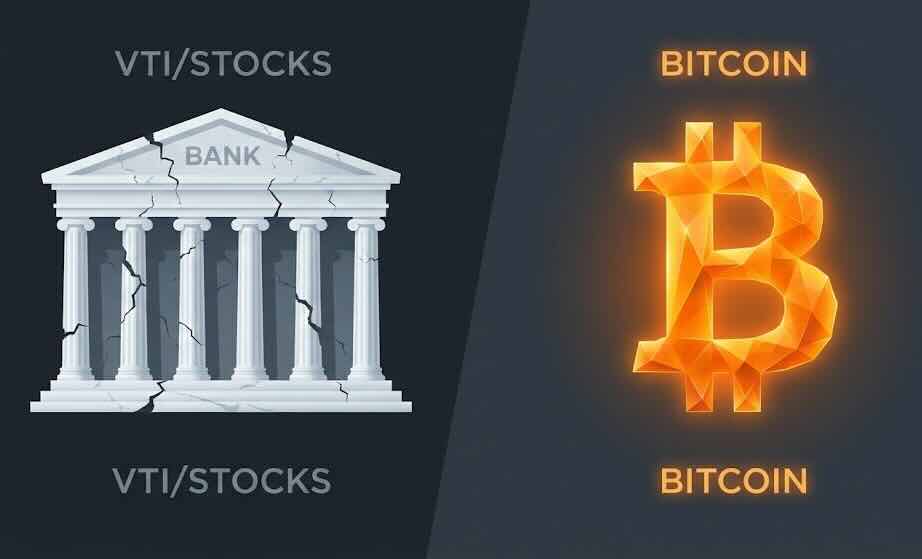

If you hang out in the Financial Independence, Retire Early community, you know the drill. Everyone loves VTI.
The Vanguard Total Stock Market ETF is the default answer for a reason. It represents the whole US economy and pays dividends. Historically, it compounds at roughly 10 percent annually. That is solid.
But the money game has changed. Inflation is sticky. The money supply keeps expanding.
VTI VS HARD MONEY
The goal is not just to grow your balance. It is to stop your purchasing power from melting away like an ice cube in the sun. This brings us to the ultimate showdown.
VTI vs Bitcoin.
One bets on American companies working hard. The other bets on math that cannot be changed. Let’s skip the emotional debates and look at the data. We will run the numbers to see how hard money changes your retirement timeline.
Key Takeaways
- The Fiat Leak occurs when VTI captures corporate growth, but its returns are denominated in dollars that are being debased, eroding real purchasing power.
- Bitcoin offers a scarcity premium because its absolute cap of 21 million units has historically acted as a vacuum for monetary premiums, outperforming broad indices over 4-year cycles.
- In our VTI vs Bitcoin simulation, allocating to scarce digital property instead of the total stock market over a decade resulted in a portfolio difference of approximately 140,000 dollars.
The Philosophy: Productivity vs. Scarcity
Before we run the simulations, we need to understand the architecture here. It is not just about price. It is about what you are actually buying.
VTI: The Bet on Corporate America
The Vanguard Total Stock Market ETF gives you a slice of over 3,700 US companies. You are betting on human productivity. You are betting on innovation and population growth.
According to Vanguard, this fund tracks the entire investable US market. It sounds safe. It sounds diversified.
But there is a catch.
VTI is market-cap weighted. As of late 2025, a huge chunk of the fund is concentrated in just a few tech giants. You aren’t just buying the economy. You are making a heavy bet on big tech.
More importantly, VTI fights against the fiat leak. If the money supply grows by 7 percent and stocks go up 10 percent, your real return is tiny. You are running on a treadmill.
Bitcoin: The Bet on Thermodynamics
Bitcoin is different. It is not a company. It has no CEO. It pays no dividends.
Instead, it offers something the stock market cannot. Immutable scarcity.
The thesis is simple. Bitcoin is digital gold for the information age. When money is printed freely, scarcity becomes a vacuum for value.
VTI prices are in dollars, which can be printed forever. Bitcoin measures wealth in a capped ledger. As the Fed expands the money supply, hard money properties become essential defense.
The Simulation: 10-Year Accumulation Case Study
Let’s stop guessing. Let’s do the math.
10-YEAR WEALTH RACE
We will compare two scenarios over a 10-year period. That is 120 months of discipline.
We assume a 35-year-old investor. They put in 1,000 dollars monthly for 10 years. We also factor in 3 percent inflation.
Scenario A: The VTI Purist
You invest 1,000 dollars per month into the Vanguard Total Stock Market. We assume an optimistic 10 percent annual return.
After 10 years, standard compounding formulas place your final portfolio value at approximately 206,552 dollars.
This is good. It preserves capital. But does it create freedom? In a high-inflation world, this path often fails to generate the escape velocity needed for early retirement.
Scenario B: The Bitcoin FIRE Architect
Now, let’s look at the Bitcoin strategy. We use our simulation tool. We assume a conservative 20 percent CAGR for Bitcoin from the current price of 86,000 dollars.
The result is different.
Your total principal is still 120,000 dollars. But your total portfolio value hits 344,311 dollars. The total profit sits at 224,311 dollars.
By switching from an index fund to hard money, the difference is over 137,000 dollars. That is the power of a higher growth rate over a decade.
Interactive Tool: Bitcoin DCA Simulator
Use the chart below. Visualize how consistent accumulation works even when the market is volatile.
👉 Run your own scenario on the Bitcoin DCA Calculator
The Retirement Test: Is It Enough?
Accumulation is only half the battle. The real test is retirement. Can a portfolio built on Bitcoin sustain you?
Let’s plug our numbers into the Retirement Dashboard. We have 344,311 dollars. We need to check if it covers a monthly spend of 1,787 dollars. That is today’s value, adjusted for inflation over the next decade.
We assume a conservative 8 percent post-retirement Bitcoin growth. We also factor in 3 percent inflation.
Interactive Tool: FIRE Simulator
Check the Decumulation Phase below. The green line represents your Safe Withdrawal capacity. The red line is your target spend.
1. Accumulation Phase (Growth)
2. Decumulation Phase (Retirement)
👉 Check your Safe Withdrawal Rate on the FIRE Simulator
The 4% Rule vs. “Infinite Growth”
If you play around with the Retirement Dashboard or the 4% Rule comparison tool, you might notice something odd.
SCARCITY WINS
When simulating Bitcoin, the Safe Limit graph sometimes curves upwards indefinitely. It never runs out of money.
👉 Compare your target against the 4% Rule Calculator
Is this a glitch? No. But be careful.
This happens because of positive compounding. If your return is 8 percent and you withdraw 4 percent, your money grows faster than you spend it. It is simple math.
But here is the reality check. Bitcoin is volatile. If you face a 50 percent crash right after you retire, that smooth graph breaks. You could run out of money fast.
The solution is a cash cushion. Keep 2 to 3 years of expenses in cash or bonds. This stops you from selling Bitcoin during a crash.
Strategic Allocation: The Barbell Strategy
Does this analysis mean you should sell all your VTI? Not necessarily.
You don’t have to choose all or nothing. The smartest move is often a barbell strategy.
Fidelity Digital Assets suggests that even a small allocation to Bitcoin improves the risk-adjusted return of a traditional portfolio. Think about that.
If VTI is your shield, Bitcoin is your spear. VTI offers stability and income. Bitcoin protects your purchasing power. Even a hybrid strategy can speed up your FIRE date.
FAQ
Is VTI safer than Bitcoin?
In the short term, yes. VTI is less likely to drop 50 percent in a month. But in the long term, VTI carries debasement risk that Bitcoin does not.
Why compare VTI vs Bitcoin?
They represent two different savings philosophies. One bets on the economy. The other bets on scarce money. You need to know the difference.
How does the Fiat Leak affect VTI?
When money is printed, stock prices go up. But the dollar value goes down. Much of your gain is just inflation. Bitcoin is designed to capture that leak.
Don’t Choose, Integrate
In the battle of VTI vs Bitcoin, the winner is the investor who uses both.
VTI gives you exposure to productivity. Bitcoin gives you protection from money printing.
By adding Bitcoin to your strategy, you aren’t just saving dollars. You are stacking sats. You are securing a piece of a finite network.
Ready to see your own numbers? Don’t just read about it.
- 👉 Run your own scenario on the Bitcoin DCA Calculator
- 👉 Check your Safe Withdrawal Rate on the FIRE Simulator