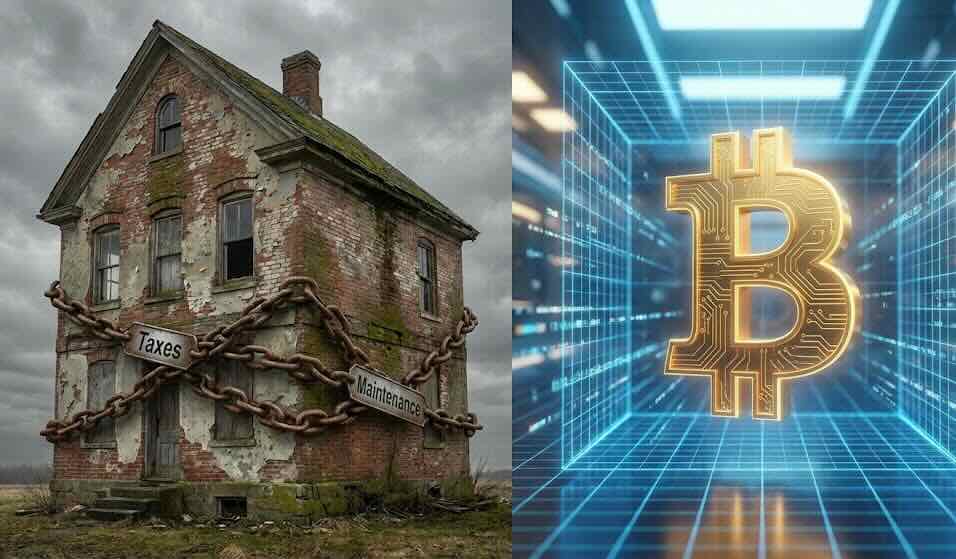

For decades, the “American Dream” of financial independence followed a specific script. Save for a down payment, buy a rental property, and let the tenants pay off your mortgage. It was the gold standard for anyone seeking passive income.
But in December 2025, things look different. With interest rates no longer at historic lows and housing prices hovering near all-time highs, the math behind becoming a landlord has changed. Meanwhile, Bitcoin has emerged as “Digital Real Estate,” a pristine asset that offers property rights without property taxes, maintenance calls, or zoning boards.
Let’s strip away the sentiment and look at the hard data. We will compare the traditional path of real estate investing against the digital path of Bitcoin accumulation. This analysis of Rental Property vs Bitcoin will determine which is the superior vehicle for Financial Independence, Retire Early (FIRE).
Key Takeaways
- The “Passive” Myth: Rental properties require significant active management (maintenance, tenants, vacancies), whereas Bitcoin is thermodynamically passive.
- Negative Leverage: In the 2025 high-interest environment, many rental properties generate negative cash flow, acting as a liability rather than an asset.
- Liquidity Premium: Selling a home takes months and costs 6% in fees. Bitcoin can be liquidated 24/7/365 with minimal friction.
The Macro Reality of 2025: Why the Math Broke
To understand the shifting hierarchy of passive income, we first need to check the stage where these assets perform. The economic backdrop of late 2025 is defined by stubborn inflation in services and the resulting hawkishness of monetary policy.
The Death of “Passive” Real Estate
The hope for a return to the near-zero interest rate environment of 2020 is gone. According to Federal Reserve Economic Data (FRED), the 30-year fixed-rate mortgage averages approximately 6.5%. This is not a temporary blip. It is a structural reset. For the real estate investor, leverage is the oxygen of the business model.
When you borrow at 3%, you get paid to hold the asset. When you borrow at 6.5%, the cost of capital often exceeds the capitalization rate (Cap Rate) of the property. This phenomenon is known as “Negative Leverage.” This is a critical factor when evaluating Rental Property vs Bitcoin, as the cost of borrowing directly impacts your Real Estate ROI.
The Hidden Costs: Rental Property vs Bitcoin
The strongest argument for real estate has always been leverage. You put $100,000 down to control a $400,000 asset. However, the term “passive income” in real estate is a bit misleading. Experienced landlords know the acronym TTT: Tenants, Toilets, and Trash.
The Silent Killers of ROI
In 2025, we are seeing a huge jump in non-negotiable costs that specifically hurt the rental side of the Rental Property vs Bitcoin equation:
- Insurance Crisis: Climate risk modeling has driven premiums up 20-30% year-over-year in many US states.
- Property Taxes: Municipalities are aggressively reassessing values to plug budget deficits.
- CapEx Inflation: The cost of labor and materials for repairs (HVAC, roofing) has outpaced general inflation.
The Calculation: A $400,000 Case Study
Let’s run the numbers on a typical single-family rental investment made today to see how the Rental Property vs Bitcoin math holds up.
Scenario: You buy a median-tier rental property for $400,000.
Down Payment: $100,000 (25%)
Loan: $300,000 at 6.5% interest.
Rent: $2,400/month (0.6% rule).
| Item | Monthly Cost | Notes |
| Gross Rent | +$2,400 | Income |
| Mortgage (P&I) | -$1,896 | 6.5% Interest |
| Property Taxes | -$416 | ~1.25% Rate |
| Insurance | -$250 | 2025 Premium Rates |
| Maintenance | -$333 | 1% Rule |
| Vacancy/Mgmt | -$240 | 10% Buffer |
| Net Cash Flow | -$735 | Negative |
In this realistic 2025 scenario, the investor is losing $735 every month. You have not bought an asset. You have purchased a second job that requires you to pay for the privilege of working. This negative cash flow is the primary driver shifting investors toward the Bitcoin side of the Rental Property vs Bitcoin debate.
Bitcoin vs. Bricks: The 2025 ROI Battle

Bitcoin: The Pristine Digital Real Estate
Bitcoin can be understood as property in cyberspace. Like Manhattan real estate, it is truly scarce. There will never be more than 21 million coins. However, unlike physical real estate, it does not degrade over time.
Zero Cost of Carry
Holding real estate costs money (taxes, insurance, maintenance). Holding Bitcoin costs nothing (assuming self-custody).
When you hold Bitcoin, you are betting on the expansion of the monetary supply. Because Bitcoin has a fixed supply cap, as the Federal Reserve prints more dollars, the value of Bitcoin measured in dollars tends to rise. It preserves your purchasing power without leaking value to local governments or insurance companies. This efficiency is a key differentiator in the Rental Property vs Bitcoin comparison.
The Liquidity Premium
If you face a financial emergency, you cannot sell your bathroom to pay a bill. You must sell the whole house. That process takes 60 to 90 days and incurs 6% in closing costs. Bitcoin provides instant global liquidity. You can sell a fraction of your holdings to cover expenses without messing up your main investment. For more on the importance of liquidity, refer to Investopedia’s guide on Liquidity.
Simulation: The Rentvesting Strategy
Here is a smarter move for the modern FIRE investor: Rentvesting.
Instead of locking $100,000 into a down payment for a cash-flow-negative property, you rent your primary residence (keeping housing costs fixed) and invest that capital into Bitcoin. This strategy leverages the superior growth potential found in the Rental Property vs Bitcoin analysis.
Stop Fixing Toilets. Start Stacking Sats.
Let’s simulate this using the DCA Calculator.
Scenario Parameters:
- Initial Capital: $50,000 (Half of the potential down payment, keeping cash reserves).
- Monthly Investment: $1,000 (The difference between renting and the costs of owning).
- Duration: 10 Years.
- BTC Price: $86,000 (Dec 2025 Base).
- Growth: 20% CAGR (Conservative projection).
Analysis of the Results
By choosing the digital path in this Rental Property vs Bitcoin scenario:
- Total Wealth: In 10 years, the simulation projects a portfolio value of roughly $660,000.
- Purchasing Power: Even after adjusting for inflation, you have outpaced the equity build-up of a negative-cash-flow rental property.
- Ownership: You would own approximately 1.0 BTC (The 21 Million Club).
Compare this to the real estate scenario, where you would likely have barely paid down $30,000 in principal while bleeding cash monthly to cover insurance and maintenance.
Planning for Retirement: The Decumulation Phase
The ultimate goal of passive income is to support your lifestyle in retirement. How does this Bitcoin portfolio translate into a retirement plan compared to traditional Real Estate ROI?
Using the FIRE Simulator, let’s see if this portfolio can sustain a comfortable lifestyle starting at age 50.
1. Accumulation Phase (Growth)
2. Decumulation Phase (Retirement)
Understanding the “Infinite Wealth” Graph
If you look at the Decumulation Phase chart above, you might notice that the green line (Safe Spend) keeps going up, even after you retire.
- The Math: This is the power of Positive Compounding. If your asset (Bitcoin) grows at 8% post-retirement, but you only withdraw 4-5%, your principal balance continues to grow faster than you can spend it.
- The Reality Check: Bitcoin is volatile. In the real world, a 50% crash could happen right after you retire. This is called Sequence of Returns Risk. The chart assumes a smooth average.
- The Strategy: To make this chart a reality, keep 2-3 years of living expenses in Cash or Short-term Bonds. This “Cash Cushion” ensures you never have to sell your precious Bitcoin during a bear market.
FAQ
Is Real Estate safer than Bitcoin?
Real estate is less volatile but carries higher liability risk. A house price doesn’t fluctuate 5% a day, but a lawsuit, a bad tenant, or a structural failure can wipe out years of profit. When weighing Rental Property vs Bitcoin, consider that Bitcoin has high price volatility but zero liability risk. You cannot be sued by your Bitcoin wallet.
What is the “Opportunity Cost” of a Down Payment?
When you lock $100,000 into a down payment, that capital is dead. It earns no yield and is illiquid. In the current market, deploying that $100,000 into Bitcoin (as seen in our calculator) often yields a significantly higher Total Return on Energy than the tiny equity buildup of a mortgage. This cost is a major factor in the Rental Property vs Bitcoin comparison.
Can I leverage Bitcoin like Real Estate?
By 2026, we expect mature lending markets where you can borrow against your Bitcoin (using multisig custody) to access liquidity without selling. This allows you to replicate the tax advantages of real estate debt (“Buy, Borrow, Die”) without the operational headaches of property management.
Choose Your Hard
- Real Estate is hard because of the physical labor, legal liabilities, negative leverage, and capital requirements.
- Bitcoin is hard because of the psychological discipline required to HODL through volatility.
In the final analysis of Rental Property vs Bitcoin for December 2025, Rental Property is revealed to be a relic of a low-interest-rate past. It has turned into a “Get Poor Slowly” trap due to operational inflation. Bitcoin, at $86,000, claims the throne as the True Passive Income King.
Stop working for your assets. Let your assets work for you.
Ready to build your own scenario? Use the DCA Calculator or the 4% Rule Calculator to verify these numbers with your own budget.